|
 |

|
Airtorch® Air & Process Gas Heaters
Volume 8 Issue 6 | March 13, 2021
|
|
|
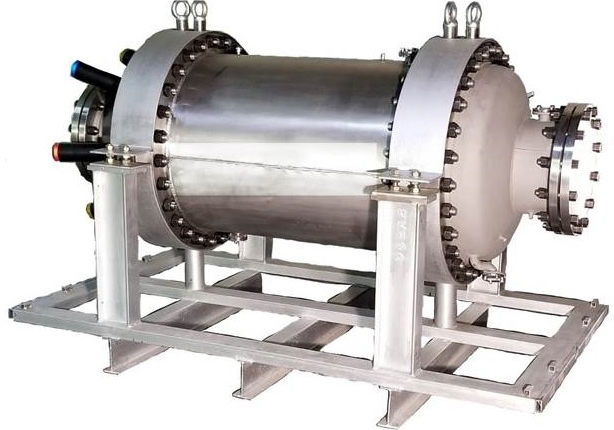
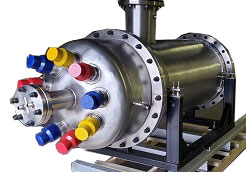
The MHI Airtorch® line of process heaters takes the uncertainty out of your heat processing needs. You will have less downtime and a lower total cost of ownership with unparalleled energy efficiency ratings, high reliability and uniformity. Use for air and process gas heating, CO2 conversion, fuel production, die heating, augmentation of existing thermal processes and testing. Constructed with modern materials, backed up by incredible warranties.
Please visit the
Airtorch® Applications page.
We offer a comprehensive line of air and gas process heating tools. Available models provide hot air flow up to 1200°C. Many Airtorch® models are compatible with fans, blowers, compressed air and gas systems because of the MHI direct flow technology.
Process Air Heater Features
-
Hot air/gas temperatures from 850°C to 1300°C (~2000°F).
- Low pressure drops even for very large flows
- Robust stainless-steel construction.
- Highly efficient. Small footprint. Mountable.
- Integrated TC allows for accurate temperature controls.
- 120/208/220/240/380/415/480V 50/60Hz input voltages available.
- Locatable control electronics (SCR, PID, over-temperature protection) available.
- Communications capabilities are included with standard Control Panels.
- MHI-DACS - Data Acquisition and Control Software compatible.
- Highly acclaimed and patented technologies. Testimonials and Awards.
- MTA and MVTA models are sealed units and have a maximum exit temperature of 925°C.
- Choice of inlet temperature on several models.
|
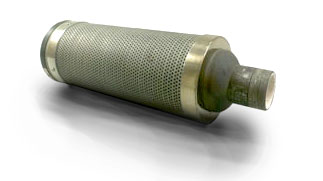
LTA750-02
MTA925-12


VTA750-04
|
|
VTA, LTA and MTA925 AIRTORCH® models are available for lower KW range.
MVTA and GVTA models are available for higher MegaWatt Ranges
|
|
|
|

LTA and VTA Airtorch® models are highly energy efficient, allowing for less energy use and higher cost savings. LTA and VTA models are fully compatible with MHI electronic control panels, allowing for accurate control of temperatures for your process

|
|
|
|
TRIVIA
We live in a strange universe where most of it is unknown to us. Many of the unknowns are beautifully explained here. Here is a sample of what we don’t know:
- Dark Energy: In the most widely accepted model of dark energy, it is an inherent property of space itself, which has “negative pressure” driving space apart. As space expands, more space is created, and with it, more dark energy. Based on the observed rate of expansion, scientists know that the sum of all the dark energy must make up more than 70 percent of the total contents of the universe.
- Dark Matter: Cannot be seen directly nor has it been detected by indirect means. Dark matter’s existence is inferred from its gravitational-like effects on visible matter, radiation and the structure of the universe. The estimate is that 84 percent of the matter in the universe does not absorb or emit light. One study suggests dark matter radiates out from Earth in the form of fine-grained streams.
While all of these are being explored we take solace that one key law is not violated. Time moves forward because of a property called entropy – there is no way to reverse a rise in entropy after it has occurred (i.e. the entropy of the universe can only increase). A small amount of space with very low entropy apparently ballooned out to what it is now. Perhaps space-time is flat so that it can expand out to infinity? Cosmologists have constructed a theory called inflation that accounts for the way in which a small volume of space occupied by a virtual particle pair (like matter and antimatter) could have ballooned to become the vast universe we see today. For several things we don’t have the tools or understanding: For example, at 200,000 atmospheres, oxygen organizes to a blue colored, strong, eight atom lattice, but we are not quite sure what happens if compressed a lot more. Or for example the exciting new Plasma that has been discovered. Why does it work?
|
|